
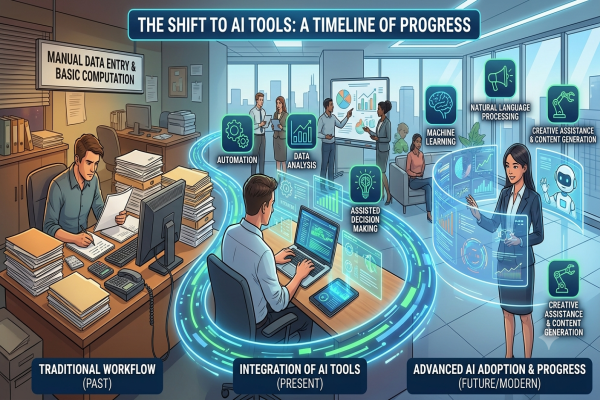
From Coders to Conductors
How AI Is Rewriting the Playbook for Software Development Companies
1 day agoNot long ago, a software development company's value proposition was simple: give us your requirements, and we'll give you developers who write the code. Headcount was the product. Man-hours were the currency. The bigger the bench of programmers, the bigger the company could claim to be. That world is quietly disappearing.
Artificial intelligence hasn't just added a new tool to the developer's toolbox — it has started to rewrite what a software company is, how it competes, what it sells, and who it hires. For an industry that has spent decades disrupting everyone else, software development is now finding itself on the receiving end of its own medicine.
The Old Playbook: Linear, Labour-Heavy, Slow
For most of its history, the software development lifecycle followed a familiar rhythm: gather requirements, design architecture, write code, test manually or semi-automatically, deploy, and then patch things when they broke. Each stage needed a specialist, each specialist needed hours, and each hour was billed.
Growth meant hiring. Client trust was built on the size of the delivery team and the seniority of the architects on a call. It was a business built on scarcity — scarcity of skilled developers, scarcity of time, scarcity of attention.
AI has attacked that scarcity directly.
The Shift: When Code Writes Itself (Mostly)
Generative AI coding assistants — tools like GitHub Copilot, Claude, and a growing wave of AI-native coding agents — can now draft functions, scaffold entire applications, write test suites, refactor legacy code, and explain unfamiliar codebases in seconds. What used to take a junior developer a full day can often be produced in a first draft within minutes.
A few concrete shifts are already visible across the industry:
- From typing to reviewing. Developers increasingly spend more time reading, correcting, and approving AI-generated code than writing it line by line. The core skill is shifting from syntax fluency to judgment.
- Compressed timelines. Prototypes that once took weeks can be built in days. Clients now expect demo-ready builds far earlier in the sales cycle.
- Automated quality gates. AI-driven testing and code review tools catch bugs, security flaws, and inconsistent patterns before a human ever looks at a pull request.
- Low-code and no-code convergence. AI is blurring the line between "low-code platforms" and "real software," letting non-technical teams build functional tools that used to require a dedicated dev team.
- AI-assisted DevOps. Infrastructure provisioning, monitoring, and incident response are increasingly handled by AI systems that predict failures before they happen rather than just reacting to them.
The Business Model Is Changing, Not Just the Tools
This is where it gets interesting for software companies specifically — not just for individual developers.
Pricing is under pressure. When a task that once took 40 billable hours now takes 10, the old hourly-rate model starts to break down. Clients are starting to ask, reasonably, why they should pay for hours when the actual bottleneck has moved elsewhere. Forward-looking firms are shifting toward value-based and outcome-based pricing instead of time-and-materials contracts.
Team structures are flattening. Smaller, AI-augmented teams are now delivering work that used to require much larger squads. A five-person team with strong AI fluency can often outperform a twenty-person team still working the old way. This is squeezing the traditional "body-shopping" outsourcing model particularly hard.
The competitive playing field is leveling — and re-tilting. A two-person startup can now ship a polished MVP that once needed a funded team of ten. That's democratizing in one sense. But it also means differentiation is no longer about who can build it — it's about who understands the problem deeply enough to build the right thing, and who can be trusted with sensitive data, compliance, and long-term architecture decisions.
New service lines are emerging. Companies are building entirely new offerings around AI itself: AI integration consulting, model fine-tuning, prompt and agent engineering, AI governance and auditing, and "AI-readiness" assessments for enterprises that want to modernize but don't know where to start.
New Roles, New Skills
The developer of tomorrow looks less like a pure coder and more like a conductor directing an orchestra of AI tools. Roles gaining traction include:
For companies, this means a hiring and training pivot: less emphasis on raw coding speed, more emphasis on systems thinking, critical evaluation, and the ability to work fluently alongside AI rather than in competition with it.
The Challenges Nobody Should Ignore
None of this is a free lunch. Software companies riding the AI wave are also running into real friction:
- Technical debt in disguise. AI can generate code fast, but fast code isn't always clean, secure, or maintainable. Unreviewed AI output can quietly accumulate into a maintenance nightmare.
- Security and IP concerns. AI-generated code can inadvertently reproduce insecure patterns or raise questions about licensing and code provenance. Over-reliance risk. Teams that lean too heavily on AI without maintaining core engineering fundamentals may struggle when something goes wrong in ways the AI can't explain.
- Client trust and transparency. Clients increasingly want to know how much of their product was AI-generated, and companies need clear policies on disclosure and accountability.
- Workforce anxiety. Developers understandably worry about what this means for job security, and companies that ignore this tension risk losing talent or morale.
What Comes Next
The software development companies that will thrive over the next decade won't be the ones that resist AI, nor the ones that blindly hand everything over to it. They'll be the ones that treat AI as a serious capability to be engineered around — with the same rigor once reserved for architecture reviews and code standards.
That means:
- Rebuilding pricing models around value delivered, not hours logged.
- Investing in AI literacy across every role, not just engineering.
- Building governance frameworks for AI-assisted development before a client or regulator forces the issue.
- Redesigning career ladders so "AI orchestration" is a recognized, respected skill — not an afterthought.
The invention of AI hasn't ended software development as a profession. It has ended software development as a linear, labour-driven profession. What replaces it is faster, leaner, and more demanding of judgment than ever before — a shift from companies that write code to companies that engineer outcomes, with AI as the tireless junior partner doing the heavy lifting in between.
The firms that understand this fastest won't just survive the transition. They'll define what "software company" means for the next generation.